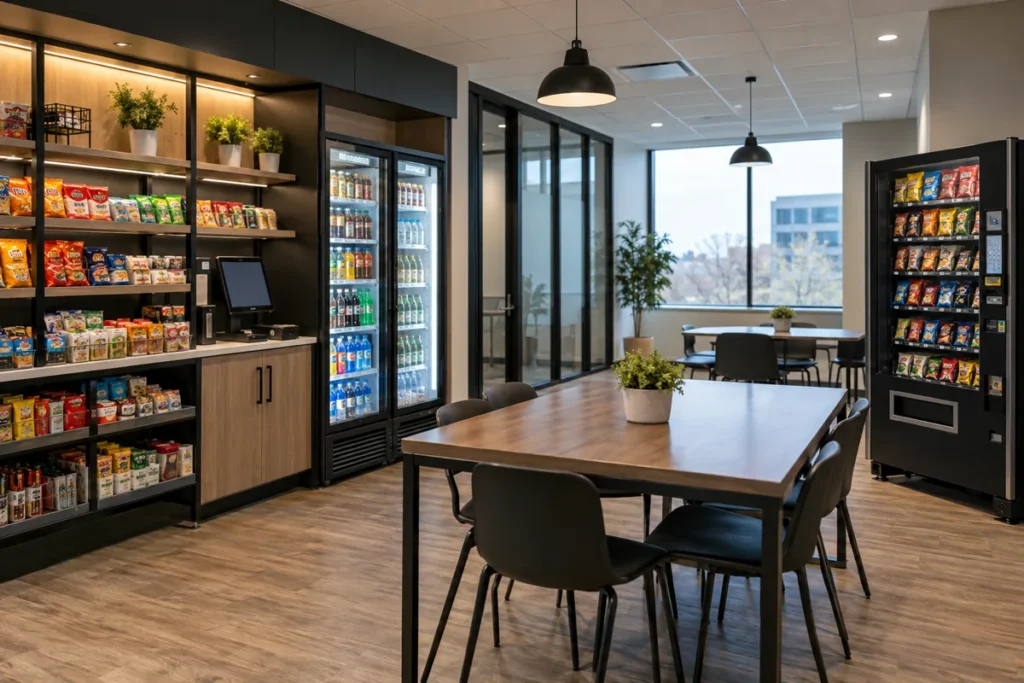
An office micro market and a bank of vending machines can both serve staff, but they use space and service differently. Compare office micro market vs vending machines around your workforce, opening hours and product needs before choosing the more attractive-looking setup.
For vending services, the arrangement should make food and drinks easy to buy while remaining practical to replenish. Ask the provider to explain the proposed equipment, payment method and service commitment rather than assuming every office qualifies for the same installation.
Micro Market and Vending Choices
Canteen describes micro markets as open-access retail areas with self-checkout and a broader range of food and drinks. Traditional vending dispenses products from machines. That difference matters when staff want fresh meals or a wider selection, but it also changes how the space is managed.
Ask for a layout showing shelves, coolers, checkout and customer circulation. A compact break room may be better served by fewer machines than an open market squeezed into the wrong space. The vending services buying guide helps you compare the service model before getting distracted by an impressive product display.
Workplace Service Requirements
Give the provider normal on-site attendance by shift, not just total employee count. Describe visitor access and whether the area is occupied overnight. Ask which arrangement it can support at that location and how sales expectations affect equipment or service terms.
Review vending services prices with the commercial arrangement explained. Find out whether there are installation charges, sales minimums, subsidies or other commitments. A provider-managed service and a business-owned retail setup are different purchases, so make sure competing proposals are for the same model.
Clarify replenishment frequency, product date checks and responsibility for cleaning around the equipment. Ask how staff request different products and how poorly selling items are replaced. A larger selection has little value if the products people want are repeatedly unavailable.
Workplace Refreshment Subsidy Example
If a hypothetical micro market agreement requires a $200 monthly employer subsidy, that is $2,400 a year. With 80 regular on-site employees, the subsidy equals $30 per employee annually, before any other employer charges. Compare that with an otherwise suitable vending proposal without a subsidy, while considering selection and service. These are illustrative economics, not a claim that micro markets normally require subsidies or that a provider will accept this location.
Payments, Losses and Support
Have the supplier demonstrate checkout and the process for refunds or payment problems. For an open market, ask how access, losses and any monitoring are handled, including who is responsible for the related costs and communications. Do not assume those issues disappear because the service is described as unattended.
Check the vending services FAQs, then compare a realistic vending proposal with a micro market designed for the same staff population. The best choice is the one that supplies appealing products, fits the room and comes with workable service terms. Start with the actual demand and responsibilities, then choose the format that delivers the strongest value for your workplace.
Ready to compare office micro market vs vending machines? Get prices for the equipment or service you need.