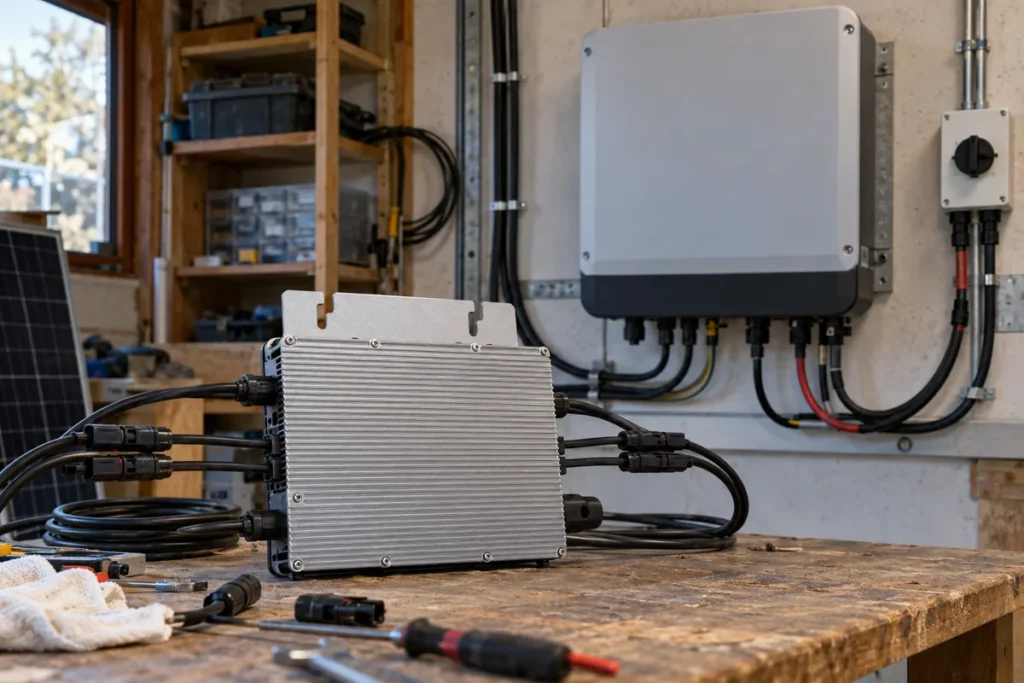
Microinverter and string inverter prices should be compared as part of the same solar installation. Request microinverter vs string inverter costs with the panels, monitoring, installation and warranty scope held consistent so you can see what the inverter choice changes.
For solar panels, the right arrangement depends on the roof and system design. Ask the installer to explain shading, panel orientation and service access before choosing a component simply because it is described as more advanced.
Microinverter and String Designs
The Department of Energy explains that a string inverter connects a group of panels to an inverter, while microinverters operate at individual panels. Its guidance notes that microinverters can cost more and can limit the effect of one panel’s shading on the others.
That does not establish the best design for every roof. Ask the installer to compare the actual options for your property, including any optimizers or other components in the proposed arrangement. The solar panels buying guide helps you evaluate the whole system rather than reducing the decision to one component name.
Installed Inverter Costs
Request an itemized equipment and installation price for each design. Identify monitoring equipment, communications hardware and any required electrical work. A component-only price may omit the labor and accessories needed to make the system operate.
Review solar panels prices with the same system size and scope. Ask the installer to explain any production difference using the same roof and assumptions. Do not treat a generic percentage improvement as a prediction for your house without a property-specific assessment.
Check the warranty terms for equipment and labor separately. Ask who arranges service, what access is required and which costs might remain with you. A long component warranty is not automatically a promise that every visit or replacement labor charge is covered.
Inverter Package Premium Example
If hypothetical installed inverter packages are $3,000 and $4,500, the premium is $1,500. Over a simple ten-year comparison that is $150 annually before financing or service differences. That is an allocation of cost, not a claim of energy savings or equipment life. Use the installer’s property-specific production assessment to judge the premium; these figures are not microinverter or string-inverter market prices.
Monitoring and Future Changes
Ask what the monitoring shows and whether any subscription or communications requirement applies. If you may add storage or panels later, have the installer explain compatibility and limitations of the proposed system. Do not assume expansion will be simple or inexpensive without a defined plan.
Use the solar panels FAQs to prepare your comparison, then request complete proposals for the designs that genuinely fit your roof. Choose the inverter arrangement that supports useful production, understandable service and a clear installed price. Paying more can be worthwhile when the specific benefits matter at your property; a higher component count or more sophisticated label alone does not establish better value.
Ready to compare microinverter vs string inverter costs? Get prices for the equipment or service you need.